Password Length vs Complexity: Why Longer Always Wins

 Apple Podcasts
 Spotify
 Castro
 RSS Feed
 Password length vs complexity isn't a close call. Dr. Mike Saylor joins Curtis and Prasanna to explain why the capital letter, the number, and the special character your bank demands do less for you than simply adding characters.
Mike walks through the rainbow table project — an operation that has spent years computing password hashes nonstop and will sell you 20 terabytes of the results. Nobody cracks your password. They look it up. The catch, and the whole reason this episode matters, is that the project has only reached ten characters after all that work.
The three also cover why some LastPass customers had their vaults drained and others didn't, where the 16-character recommendation comes from, how to build a passphrase you'll remember, whether forced password rotation accomplishes anything, and what happened when Mike rolled out fingerprint-locked laptops to fifty field employees.
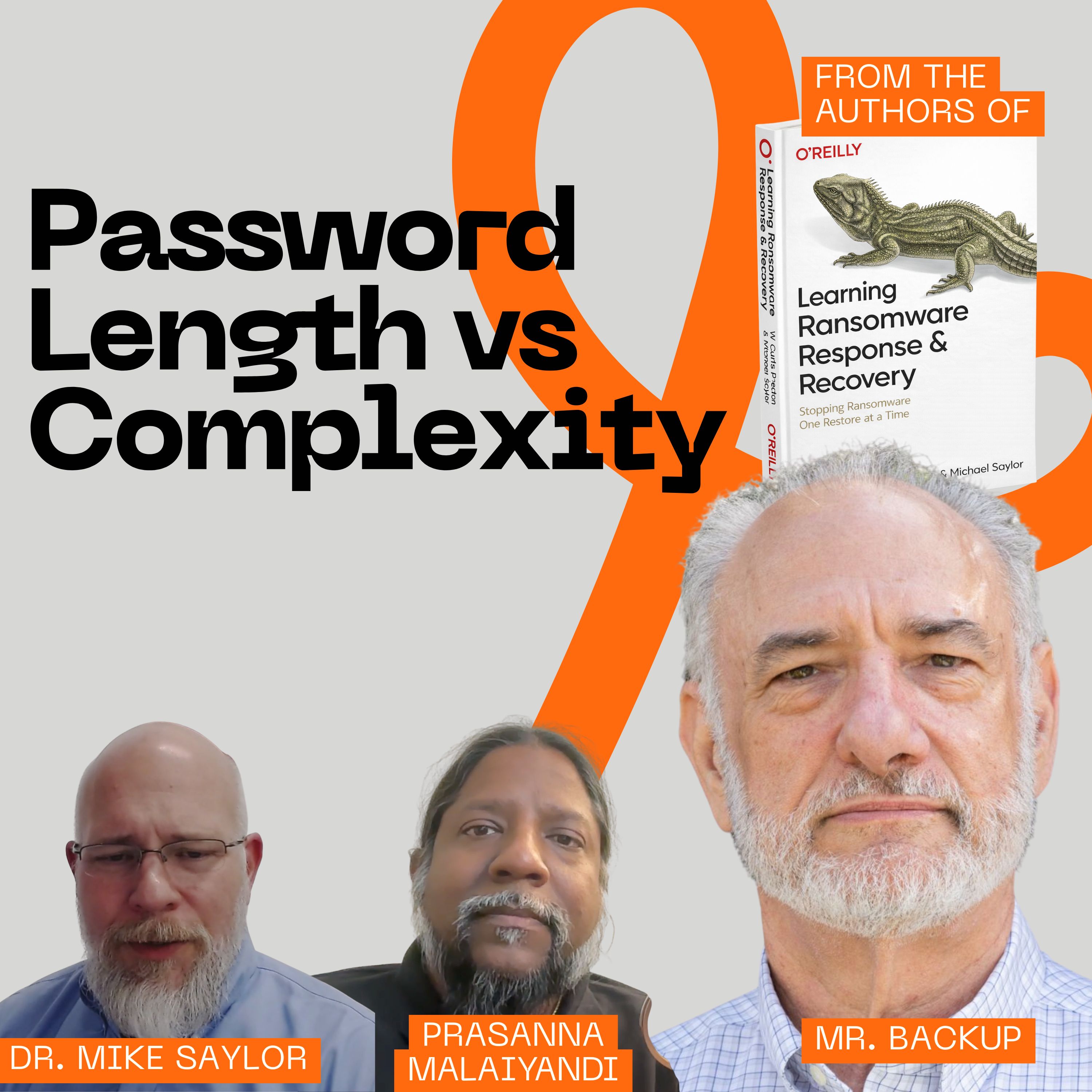
Get the book: Learning Ransomware Response and Recovery at stopransomware.com
Every site that you log into wants a capital letter, a
Speaker:number, and a special character.
Speaker:But guess what?
Speaker:None of that matters as much as how long your password is.
Speaker:Dr. Mike Saylor joins Prasanna and me to explain why.
Speaker:Mike is the co-author on Learning Ransomware Response and Recovery,
Speaker:and he's got receipts, including 20 terabytes of pre-computed password
Speaker:hashes that you can just go buy, uh, which is the reason that nobody even
Speaker:bothers cracking passwords anymore.
Speaker:They just look 'em up.
Speaker:There's a hard limit to how far these guys have gotten, and, uh,
Speaker:get past that limit and your risk goes way down, for now at least.
Speaker:We also get into why some LastPass customers lost everything and others
Speaker:didn't, whether passphrases actually work, and if forcing people to rotate their
Speaker:passwords does anything but annoy them.
Speaker:If this is your first time watching or listening to me, I'm
Speaker:W. Curtis Preston, AKA Mr. Backup.
Speaker:I've been obsessing about backup, recovery, and now cyber
Speaker:recovery for over 30 years.
Speaker:If that's your bag, I'm your guy.
Speaker:You're not gonna find anyone that cares about this topic more than me.
Speaker:Ever since 1993 when I had to tell my boss that there were no backups of
Speaker:the database that we had just lost.
Speaker:Now I've written five O'Reilly books, a blog, and this podcast.
Speaker:Here we turn unappreciated admins into cyber recovery heroes.
Speaker:This is the Backup Wrap-Up
Speaker:Welcome to the Backup Wrap Up.
Speaker:I'm your host, W. Curtis Preston, and I have with me once again the flowing
Speaker:mane of hair from Prasanna Malaiyandi.
Speaker:How's it going, Prasanna?
Speaker:I'm good, Curtis.
Speaker:I know.
Speaker:I was like, "Who is he talking about?"
Speaker:Yeah, I think we know who we're not talking about.
Speaker:Just saying.
Speaker:You doing all right over there?
Speaker:could also say his beard is, know
Speaker:Yeah, I'm just, I'm just, I'm trying to become Mike is what I'm doing
Speaker:here with the… It's just creeping further and further back on everything.
Speaker:But anyway, speaking of Mike, thanks for joining us again, Mike
Speaker:Sure.
Speaker:Thanks for having me.
Speaker:once again Dr. Mike Saylor, and he is my co-author on the book that
Speaker:is over my right sh- left shoulder.
Speaker:if you're watching us on YouTube, it is Learning Ransomware Response and
Speaker:Recovery, which, came out in, March.
Speaker:And, selling like hotcakes, at your local bookstore.
Speaker:I doubt it's at your local bookstore, but you can order it at your
Speaker:favorite internet-based bookstore, wherever that happens to be.
Speaker:and, I will say if you order it directly from O'Reilly, you and I
Speaker:make a little bit more money, but I don't know if anybody cares about that
Speaker:Is, is the audio version available?
Speaker:The audio version is available on, on Amazon.
Speaker:if
Speaker:ask me about that recently
Speaker:Yeah.
Speaker:Yeah.
Speaker:it is really weird to hear your book read to you by someone else.
Speaker:I just, I have actually listened to the audio version, and it was just odd, right?
Speaker:but yeah, it is available, and for those of you that like to listen
Speaker:to audiobooks, it's a page-turner.
Speaker:What do you call that with, in an audiobook version?
Speaker:Anyway, we're working through the book and going through a couple of
Speaker:different topics, and today we're talking about password managers.
Speaker:And we can talk about something that's come up a lot here, our least favorite
Speaker:password manager, that would be LastPass, and why is that, Prasanna?
Speaker:Why have they come up more than once on the pod?
Speaker:Boy, because they were and all of the password vaults that people were using
Speaker:were stolen, and then they sort of covered it up and said, "No, don't worry about
Speaker:it. It's okay. They didn't really get the password vault." And then it was found
Speaker:out they got the password vault, and then it was found out, yes, these password
Speaker:vaults could be cracked, and supposedly people with a bunch of cryptocurrency
Speaker:have had their wallets drained.
Speaker:Whether or not they're necessarily related, it's hard to say definitively,
Speaker:but it looks like there is a pattern
Speaker:I think at least one blogger says that he believes he has proof that
Speaker:the, the, that it, that what was happening is directly related to the,
Speaker:y- you know what I'm trying to say.
Speaker:Dang it.
Speaker:Oh, and, oh, one
Speaker:yeah
Speaker:add to that is, what ended up happening was LastPass was backing up the vaults,
Speaker:and they had a custom script in order to be able to do that, and they had
Speaker:hard-coded the password the script in order to be able to do the backups
Speaker:No bueno.
Speaker:The reason why that's relevant to the topic at hand is the people who had their
Speaker:passwords actually fully compromised were the ones that had passwords that
Speaker:were short enough to guess, right?
Speaker:and so because when you have a password manager that isn't a complete
Speaker:piece of crap, it's not storing the passwords in plain text, right?
Speaker:It's storing the passwords encrypted with some salt, right?
Speaker:So the only way to guess a password is to encrypt it similarly and then
Speaker:compare the encrypted result, right?
Speaker:And the people who had their passwords ultimately stolen via this hack is
Speaker:because their passwords were two things.
Speaker:They were short enough, and also they were encrypted with
Speaker:an older version of the product.
Speaker:And so it was, I think the salt was smaller or something like that, right?
Speaker:and so those two things together.
Speaker:So really when we put all that together, we have the phrase that comes up a lot,
Speaker:Mike, which is length over complexity.
Speaker:when we think about all of the things that we've done to make passwords more
Speaker:secure, one of the things anybody who's logged in any- anything in the last,
Speaker:I don't know, 20 years has been told, "Nope, that password's not secure enough.
Speaker:You need to add a, a capital letter." And then it's oh, you need to add a, a,
Speaker:you know a number. And then it's like, "Oh, you need to add a special character.
Speaker:No, not that special character." and, by the way, there's actually a comedian
Speaker:that I saw do this bit where he, Y- what, you know the one I'm talking
Speaker:about, right? Where he just one by one adds… Yeah, and so the people, they're
Speaker:like, hey, we're gonna change the S to a dollar sign. They'll never guess
Speaker:that." so that's complexity, right?
Speaker:The, making the password more and more complex.
Speaker:And I use a password manager, and one of the things that it
Speaker:does is it automatically creates a super complex password.
Speaker:But what do we mean when we say length over complexity?
Speaker:it's a math problem.
Speaker:so the longer your password is, the longer the math problem is.
Speaker:So if you've got a eight-character password, even with complexity, you're
Speaker:st- it's still eight characters.
Speaker:still the same eight-character math problem.
Speaker:that's a math problem if your is to do math, like I'm gonna
Speaker:try and crack this password.
Speaker:Nobody does that anymore, and they haven't for a long time.
Speaker:If you're a legit password-cracking bad person, you're gonna go buy tools, and
Speaker:you mentioned this already, if I've got an eight-character encrypted password,
Speaker:I just need to go encrypt stuff until the encryption, the, the encrypted
Speaker:password looks the same as this one.
Speaker:Right
Speaker:So that's a ha- they call that a hash.
Speaker:So the encrypted password results in a hash value, and that's
Speaker:the result of a math problem.
Speaker:I just need to go encrypt a bunch of stuff until I come up with the same math answer
Speaker:you went through to encrypt your password.
Speaker:there's a project, and it's been going on for years, called Rainbow Tables,
Speaker:and you can go to their website and buy six terabytes of math answers.
Speaker:Oh, where they've already encrypted, encrypted a bunch of passwords?
Speaker:still do this.
Speaker:they've done this 24 hours a day, seven days a week, across
Speaker:every platform that's out there.
Speaker:It's a nonprofit organization.
Speaker:that was my air quotes.
Speaker:and you can buy the entire database of encrypted hashes with the,
Speaker:respective clear text password.
Speaker:And so now you're not doing math, you're just comparing all the hashes
Speaker:that you wanna look up, and that's really what it is, and you're looking
Speaker:it up in this Rainbow Table database.
Speaker:I think the, the version we purchased, man, eight or years ago was, it was
Speaker:up to six terabytes of text files.
Speaker:A
Speaker:that's a lot of text files!
Speaker:And and just to give you an example of how much data that is, just
Speaker:doing the lookup took three days.
Speaker:That's how much data there was.
Speaker:But yeah, if I can get your encrypted eight-character password, your
Speaker:hash, I'm just gonna go look it up.
Speaker:That's why passwords are irrelevant today, and that's why it doesn't mean,
Speaker:it doesn't make sense to force users to change passwords every 30, 90, 100, and
Speaker:whatever days, unless you're a regulated industry that's a checkbox you gotta do.
Speaker:Because if a bad guy can get the hash, they can get the password
Speaker:Like, question for you on the hash, because I know sometimes when hashing
Speaker:you can pass in a salt, right?
Speaker:Or something, a variable, if you will, in order to ensure that what
Speaker:comes out isn't always the same.
Speaker:In the case of the passwords that are being generated and the
Speaker:hashes here, is that not the case?
Speaker:It is, and that's why I meant, so the, the rainbow tables, they're,
Speaker:creating these across all of the available systems in their project.
Speaker:So Linux, all the different flavors of Linux with Salt, Linux without
Speaker:Hmm.
Speaker:Windows, every version of Windows with LTM, LAN, hashing, on, with it
Speaker:turned off, Cisco VPN, Office 360.
Speaker:they're, everything that they can get their hands on to do these, math problems,
Speaker:they're doing it, and they're creating a catalog, and they're selling it
Speaker:Wonder, I wonder how many different types of systems they're doing that for
Speaker:I will ask while we are talking
Speaker:The, that, that's actually both fascinating and terrifying
Speaker:all, all at the same time.
Speaker:so i- if there's just a database then of all of the available passwords and hashes,
Speaker:z- from those passwords, why then do we care about, com- length of a password?
Speaker:'Cause it's still a math problem.
Speaker:so eight characters is obviously an easier math problem than 15 characters.
Speaker:but it also, lends itself to Difficulty.
Speaker:And so when someone sits down at your desk and tries to guess your
Speaker:password, they're gonna look around at all your notes and all that stuff,
Speaker:and they're gonna, my dog is hal.
Speaker:the longer that password is, the longer it's gonna take them to figure it out.
Speaker:And the more times they try to figure it out, hopefully you've got your
Speaker:system configured to that user account after so many failed login attempts
Speaker:Is it the case that given that this project has been running for 15 years,
Speaker:and given the fact that they have to, support, for lack of a better word, so
Speaker:many different systems, that they have to do this, this password, for every
Speaker:different system that they support, can we assume that they haven't gotten very
Speaker:far in terms of length of passwords?
Speaker:doing some research on the Rainbow Tables project, they, their hashing,
Speaker:activities include LM, NTLM, so LanMan, NT La- NT LanMan, MD5, SHA-1,
Speaker:and only-- they're currently only up to password length of 10 characters.
Speaker:And having done all of that, the database is currently at just over 20
Speaker:20 terabytes of text file
Speaker:they've yet to, to really expand, let's see, common hashes, MD5,
Speaker:SHA-1, SHA-256, and SHA-512
Speaker:Hey
Speaker:is where they're at.
Speaker:Like one of the things
Speaker:AES
Speaker:what does that mean, by the way?
Speaker:For the, for those that don't know what you're talking about, what, when
Speaker:we talk about SHA-1, SHA-256, SHA-5, what, what are you talking about there?
Speaker:So the MD5 is the fifth version of a, of an encryption or hashing algorithm.
Speaker:so fingerprinting a file.
Speaker:and the same thing with SHA.
Speaker:SHA-1 is the first version of SHA, and I can't remember what SHA stands for.
Speaker:but they're, they've been around forever, probably 40 years at
Speaker:Ever.
Speaker:Yeah.
Speaker:and then SHA-256 and SHA-512 are the size, so 256-bit, 5- 512-bit, the size of
Speaker:that encryption value or that hash value
Speaker:And so that, that, that's gonna… The, so when we say SHA-512,
Speaker:doesn't it mean that it's a f- is the, the hash is 512 bytes long?
Speaker:Is that what that means?
Speaker:That's correct.
Speaker:Yeah.
Speaker:similar like AES 256, AES 512, it's the, the, the bits in the encryption value.
Speaker:And
Speaker:But I'm
Speaker:when you, look at how long do I need… How long would it
Speaker:take to, to crack a SHA-512?
Speaker:It's like 300 years if you do the math.
Speaker:don't have to do the math anymore.
Speaker:You just have to compare… You just have to capture the hash then go compare it
Speaker:to somebody else that's already done the math or done the exercise the same hash.
Speaker:One, and by the way, those are all just current day problems.
Speaker:the quick evolution of quantum computing, even more complicated
Speaker:encryption and hash values that I can capture today, I don't have to wait
Speaker:300 years to break that, that math.
Speaker:I just have to wait another five or 10 until quantum computing's available
Speaker:for me to throw that at it and have it you know, decrypt it in real time.
Speaker:This is why people don't like you, Mike
Speaker:there's a whole lot of bad guys that are just, capturing encryption
Speaker:now s- and knowing that they'll be able to decrypt it in the next
Speaker:couple years in a fairly near term
Speaker:Yeah.
Speaker:See
Speaker:quantum safe algorithms now, right?
Speaker:In order to be able to handle the upcoming that yes, everything
Speaker:you're doing now can be cracked
Speaker:Right.
Speaker:But having said that, at least the current technology that's available, right?
Speaker:There is a table that we used in the book that, basically gives a, a certain
Speaker:number of years that it would take to crack a password of a certain length.
Speaker:And so I believe the current recommended size is at least 16 characters.
Speaker:Does that sound about right, Mike?
Speaker:I would say so.
Speaker:and a- along those lines, the longer the password gets, the
Speaker:more ridiculous the word gets, like supercalifragilistic, right?
Speaker:That might be a word, one-word password, but y- really gotta evolve, migrate
Speaker:away from passwords into passphrases.
Speaker:passphrases starts touching on the next evolution of MFA, that's cognitive MFA.
Speaker:It's like only you would know that part.
Speaker:only you have experienced that thing, so only you would know, what the
Speaker:missing piece is or what the answer to this question is or… it's very
Speaker:similar to, I wanna do my credit report, and so my credit, the reporting
Speaker:agencies know everything about you.
Speaker:And so it's not just your name, Social Security number, your date of birth.
Speaker:They're like, how much is your car payment?
Speaker:How much, when, what's the address you lived at when you were 20 years old?"
Speaker:Right
Speaker:So those are cognitive things, or for the most part.
Speaker:if I did enough reconnaissance on you, I could probably figure those things out.
Speaker:It wasn't breached or leaked
Speaker:Yeah.
Speaker:it's more personal than just the data that might be part a profile or
Speaker:what I find super frustrating is when I get one of those cognitive
Speaker:tests and I don't pass it.
Speaker:For me, that's very frustrating.
Speaker:They're like, "Which of the following, which of the following addresses
Speaker:is associated with you at some point?" And I'm like, I don't know.
Speaker:I think… I don't think it's any of them, but…"
Speaker:And then they're like, "Sorry, we could not, authenticate you."
Speaker:And that is a sneaky question.
Speaker:Sometimes they give you a list and the right answer is none of these.
Speaker:yeah.
Speaker:so I, I, that, by the way, I… Go ahead
Speaker:So Mike, it's interesting you talked about sort of moving
Speaker:from passwords to passphrases.
Speaker:Do you know if there's been re- Because I know s- sometimes it's hard to remember
Speaker:passwords, Which is why people in the past tended to use the same password
Speaker:over and over and over everywhere, right?
Speaker:Or some variation.
Speaker:passphrases, do you know if been research done to figure out, like,
Speaker:are people able to remember these a lot easier than the passwords that
Speaker:you used to have for individual sites?
Speaker:Don't know that.
Speaker:But I think the approach would be similar.
Speaker:so with your passwords, you're not supposed to use the same
Speaker:password for different things.
Speaker:So you've gotta come up with a way of remembering what
Speaker:password goes with what thing.
Speaker:very similar with your passphrase.
Speaker:passphrase should help you relate the phrase to whatever
Speaker:it is you're logging into.
Speaker:if you're logging into work, your passphrase could be, "I really
Speaker:wish I didn't work here," or, "I'd rather be fishing," right?
Speaker:so y- 'cause that's something you feel or comes to mind when you go to log in.
Speaker:versus your bank, I love rolling in cash." something like that. my
Speaker:account's not negative again." But, something that's related to what it is
Speaker:you're logging into is very helpful, and that's the, it's individualized.
Speaker:So whatever it is that you've had to do to remember the password for this
Speaker:thing, yeah, I think you would carry that forward to developing a passphrase
Speaker:for that, along those same lines
Speaker:The, I, I guess may- maybe because it was a pretty long time ago that I migrated
Speaker:to everything being in a password manager, and so I don't even, I don't
Speaker:even go down that… I never went down that path of thinking about passphrases.
Speaker:But I think if I would, if I did that, I would use it for
Speaker:a handful of accounts, right?
Speaker:Where, 'cause I, I can't… There's no way that my brain could remember the
Speaker:passphrases for as many as o- as many online accounts as I have, so that's
Speaker:why I've got to have a password manager.
Speaker:But I can see potentially using that, like you said, for logging
Speaker:into work, for logging into, a s- a smaller set of critical things.
Speaker:Is that, does that seem appropriate?
Speaker:and I'll add to that, we've talked about this Rainbow Tables project.
Speaker:When they're taking dictionary words and combinations of dictionary
Speaker:words, dirty cat, big dog, right?
Speaker:So they're doing that in an effort to create these encrypted
Speaker:hashes for your lookups.
Speaker:what becomes exponentially harder and will dura- you know, draw out
Speaker:the duration of their project so much longer are these passphrases.
Speaker:Curtis's password might be, "The big dog, eats steak." Prasanna's could
Speaker:be, "The big dog eats steaks," plural.
Speaker:those two passphrases are completely different and when you
Speaker:encrypt them and hash them, even though there was only one letter.
Speaker:then what if the big dog eats steaks, back to that, that comedian where,
Speaker:I'm gonna replace E's with threes, and I'm gonna capitalize the first
Speaker:letter of each word, things along…
Speaker:So that, that completely changes the hash value, and that, that is so much
Speaker:further down the line of the Rainbow Table project, math problems than
Speaker:just the simple word combinations.
Speaker:And many words there are in the American dictionary, guess, there,
Speaker:there's probably a math formula for figuring out how many passphrases
Speaker:that you can make in, 16 characters.
Speaker:Exponentially harder than the 10 character password combinations
Speaker:Yeah.
Speaker:So when we talk about work, is it, does it make sense to, for work
Speaker:passwords, where we're using passwords and not pass keys, does it make sense
Speaker:to mandate a password length then?
Speaker:Yes
Speaker:and,
Speaker:I think 16 characters is appropriate
Speaker:Yeah.
Speaker:By the way, speaking of things that annoy me, you know what annoys me?
Speaker:Is sites that go, "I'm sorry, your password is too long," or, "I'm sorry,
Speaker:but your password is, has a special character that we don't like." Those two
Speaker:things really annoy me, 'cause I've gone to 20 characters wherever I can, right?
Speaker:and and they're like, "I'm sorry, that's too big
Speaker:My favorite is thinking I'm using the right password, for it only to not
Speaker:work, and then I forgot my password.
Speaker:So you change your password to the one you thought you were using, and it says you
Speaker:can't change it to the current password.
Speaker:I just tried that
Speaker:Yeah, I've seen that.
Speaker:or the, the, "I'm sorry, you can't change it to that 'cause that was
Speaker:a previous password." some of them have they track the last three
Speaker:passwords and, and you can't change it
Speaker:too.
Speaker:I know it's frustrating to some people, important because that previous
Speaker:password may be the one that was compromised in some breach some time ago.
Speaker:So you're safe today because you're using a new password, but if
Speaker:Right
Speaker:to use an older password, it could have been one that was compromised.
Speaker:So
Speaker:And that's why they do it.
Speaker:good policy
Speaker:yeah, I, yeah, I'm not saying that was one ano- that annoys me, but
Speaker:it's annoying when it happens when you're trying to do something, right?
Speaker:And I'll add this too.
Speaker:I mentioned that 16 characters I think is appropriate, but it does depend on
Speaker:all the other stuff that you m- you're h- hopefully doing or could do mitigate
Speaker:the risk of an il- an illegitimate login or someone stealing your credentials.
Speaker:There are so many other settings and tools and layers that you could
Speaker:hopefully put in place or are in place that could mitigate the risk of a
Speaker:shorter password or even a compromised
Speaker:Prasanna, one of the things that we talk a lot about is password managers,
Speaker:and when we're talking about using this for work, there's thing we,
Speaker:there's a, there's enterprise-wide or commercial level password managers.
Speaker:y- you have any thoughts on that?
Speaker:yeah, no, I think enterprises should be using a password manager because
Speaker:otherwise people are gonna be y- storing passwords in their web browser or using
Speaker:the same passwords across multiple systems, all the rest of those things
Speaker:which you don't want as an enterprise, especially if you have, like, admin
Speaker:level accounts or things like that.
Speaker:And so I think going with an enterprise solution or a single sign-on solution,
Speaker:I know Microsoft has one with, I think it's now Entra, And, or you can look at
Speaker:Okta or any of these other companies in order to be able to provide this sort
Speaker:of mechanism so you don't necessarily need to remember all the passwords,
Speaker:which I know that SSO is slightly different than a password manager, but
Speaker:I think it sort of solves the same issue
Speaker:Yeah, SSO is very different, right?
Speaker:But you can connect a number of applications, especially SaaS
Speaker:applications, to your SSO and, it would, I would argue that a strong sing- s-
Speaker:a strong s- single sign-on system is probably, there's no probably, is more
Speaker:secure than 150 different passwords that I am forced to store in a password manager.
Speaker:If we can have a single, to go back to the previous episode, MFA protected, phishing
Speaker:resistant, MFA protected single password that I need to use for work, that is
Speaker:then going to have policies enforced on it, that to me is much more secure than
Speaker:any password manager, and that way you can say, "Just use this one password."
Speaker:Having said that, I'm still not a fan when we talk about like Entra
Speaker:ID, I'm still not a fan when we start talking about backup systems.
Speaker:I'm not a fan of having, them stored in the same whatever you have,
Speaker:either SSO or, password manager that you have for the company.
Speaker:I don't like that because if it's ultimately compromised,
Speaker:then, that's a, a problem.
Speaker:Mike, you talked a, a little bit about this and one, final thought about,
Speaker:passwords is that, this idea of forcing people to, automatically rotate.
Speaker:I know there's some situations where that might be a good idea, but in general, my,
Speaker:my opinion has been in general enforce a really long password and, a- and then not,
Speaker:and then don't force people to rotate it.
Speaker:Any, any thoughts on that?
Speaker:Yeah, this kind of goes back to my comment on, it depends.
Speaker:It depends on what else you're doing, and it depends on why you
Speaker:need to enforce a, a password change, whatever the frequency is.
Speaker:If it's six months or one year, why?
Speaker:Why are we doing that?
Speaker:regulatory compliance requires it.
Speaker:know, CMMC or the, cybersecurity maturity model for organizations
Speaker:that do business with the US government, have to have that setting.
Speaker:They have to do it.
Speaker:so why?
Speaker:Why do we have to do it?
Speaker:If you don't have to do it, why is it there?
Speaker:it there because we're lazy, and I need somebody to tell
Speaker:me when to change a password?
Speaker:Are we lazy on the IT side, where we're not reviewing system access enough,
Speaker:and I'm gonna rely on that password expiring to save my butt from having
Speaker:not disabled that user when they left two months ago, So there's that.
Speaker:it's why.
Speaker:if you can, absolutely enforce longer passwords, and if you've got other
Speaker:good controls in place like MFA, login and session restrictions, session
Speaker:timeouts, all these other good things, risky sign-ins, geographic limitations,
Speaker:concurrent logins, not being able to log in locally for, privileged accounts.
Speaker:there's so much you could do, and if you're doing good stuff, then absolutely
Speaker:you can rely on passwords a little longer
Speaker:The, the, the one thing I wanted to ask is, does your position
Speaker:change on password expiration if they're using a password manager?
Speaker:as a … Like, if for instance, the main password to access a password manager
Speaker:expired, but the individual passwords for the individual services rotated, as an end
Speaker:user, it's no different if I have to reset that password other than sort of having to
Speaker:go and go through the reset flow, right?
Speaker:But I don't need to remember anything other than my master password, right?
Speaker:So does it really make a difference?
Speaker:Depends.
Speaker:It's, I'm gonna get a shirt that just says, "It depends," or wear a hat.
Speaker:One of the two.
Speaker:it depends.
Speaker:So how religious are you at protecting your password
Speaker:manager and that one password?
Speaker:if, I'm able to get on your machine while you're doing your password
Speaker:manager, and I can see all that stuff, then it doesn't make any difference.
Speaker:If it's on a USB drive and you let your grandkids y- chew on that like a
Speaker:pacifier, it's probably not a good idea.
Speaker:j- it just, it truly depends, and it, and on a personal note, you've gotta, assess
Speaker:your own risk, and on, from a company perspective, it comes down to the weakest
Speaker:link, and the weakest link are people.
Speaker:And if you're relying on just that one pass- It's, and it's no
Speaker:different than single sign-on.
Speaker:Single sign-on is great from a usability and sometimes from a security perspective,
Speaker:but I've been on so many incident responses where the, the user credentials
Speaker:were compromised, legitimate-looking login to the environment that gave
Speaker:that bad guy access to everything.
Speaker:And so very similarly, it's just the one key that unlocks
Speaker:everything, and, I don't know.
Speaker:It depends
Speaker:That's sort of like the opposite of what you would want in cybersecurity
Speaker:with isolation and sort of fault domains and everything else.
Speaker:Yep.
Speaker:That's one of the reasons I'm glad the smart grid initiative fell
Speaker:apart, where all the people's, everybody's power meters and all that
Speaker:Mm-hmm.
Speaker:are all gonna be talking and all this, just
Speaker:Simplicity is the friend of the bad guys.
Speaker:You want complexity.
Speaker:The more complex something is, the less… more effort it's gonna take,
Speaker:and, bad guys are lazy for the most part.
Speaker:Yeah, it's that eternal war between complexity and usability, right?
Speaker:or security and usability, right?
Speaker:That you, again, my personal opinion for what it's worth is to simplify
Speaker:it as much as possible for the user, but add that security, right?
Speaker:If you make it too complex, if you make it too much of a pain in
Speaker:the butt, if they're able to go around it, they will go around it.
Speaker:and Mike, you talked about, in our pre-call, you talked about,
Speaker:an environment where you said that you would enforce something on
Speaker:laptops and then what happened?
Speaker:Yeah, I was hired by an organization to become their chief security
Speaker:officer because of a security event.
Speaker:event was, two field employees working out in the field, stopped at dinner somewhere.
Speaker:bad guys broke into their car, stole two laptops.
Speaker:The laptops had a combined three hundred years of client data on them.
Speaker:So they hired me to figure out what happened and how do we
Speaker:prevent this from happening again.
Speaker:One of the solutions was new laptops, 'cause the older ones couldn't…
Speaker:weren't capable of these new controls.
Speaker:New laptops, encrypt the hard drives, integrate the encryption password and
Speaker:the BIOS and the Windows into a So you, you log in with your credentials, you
Speaker:have to scan your fingerprint, and that's the multi-factor, something you know,
Speaker:something you have, or something you are.
Speaker:and then so we deployed that, fifty laptops out to the field.
Speaker:Forty-nine people complained and completely resisted, "We
Speaker:will not use this laptop."
Speaker:One other thing I do wanna add, as far as the description of the controls,
Speaker:the laptops had cameras, on the lid, and the camera would actively
Speaker:look for the presence of a person.
Speaker:So it's not, taking pictures of you.
Speaker:It just wants to know there's a person in front of the computer so
Speaker:that when I get up and move away, it automatically locks the screen.
Speaker:So just more security controls.
Speaker:But forty-nine of fifty people said, "It violates my privacy. I'm old, I don't
Speaker:have good fingerprints, so that's a, an accessibility violation." All this stuff.
Speaker:And so for all of the months of work we put into implementing security,
Speaker:politics defeated it all in a week.
Speaker:And we had to shut it off and let 'em do things the way they used to do it.
Speaker:But that was a business decision.
Speaker:It went Very well
Speaker:going back to something we talked about on the last episode, the idea being that
Speaker:perhaps this is something, these things like enforcing really long passwords,
Speaker:enforcing MFA, and other th- these things like you talked about with the
Speaker:laptops, that perhaps if you can start with the, the privileged accounts, right?
Speaker:It's a smaller number and it's, it's a group of people that theoretically
Speaker:would be, what do you call it?
Speaker:Would be more amenable to this type of control.
Speaker:All right.
Speaker:thanks again, Prasanna, for your, your wisdom as well
Speaker:I'm gonna figure out how long of a passphrase I can start creating.
Speaker:Thanks, Mike
Speaker:You're welcome.
Speaker:Mine's 24
Speaker:Nice.
Speaker:All right.
Speaker:And once again, thank you to the listeners.
Speaker:You're why we do this.
Speaker:And, buy my book.
Speaker:All right.
Speaker:Have a good day
Speaker:The Backup Wrap Up is written, recorded, and produced by me, W. Curtis Preston.
Speaker:If you need backup or DR consulting, content generation, or expert witness
Speaker:work, check out backupcentral.com.
Speaker:You can also find links for my O'Reilly books on the same website.
Speaker:Remember, this is an independent podcast, and any opinions that
Speaker:you hear are those of the speaker and not necessarily an employer.
Speaker:Thanks for listening